







The most common gardening regret is planting for summer and overlooking the other nine months of the year. A garden that performs beautifully in July and August but offers little between October and May is delivering only a small fraction of its potential — and is making work for itself in the form of annual cycles of replanting, lifting and storage. The solution is not more effort; it is smarter plant selection. A carefully built palette, incorporating evergreen structural planting, reliable hardy perennials, ornamental grasses and well-chosen bulbs, produces a garden that changes beautifully and continuously through the seasons without demanding constant intensive intervention. Here is how to construct that palette.
Structural evergreens that anchor the scheme
Every garden, regardless of its style, size or location, benefits from a framework of evergreen planting that maintains visual structure and genuine interest through the winter months. These are the plants that give the garden its bones and its consistency — they ensure that even in January and February, when deciduous plants have retreated, the garden still has form, texture and the quiet satisfaction of a considered space.
Box (Buxus sempervirens) has historically been the most widely used plant for clipped topiary, formal edging and low structural hedging. However, the increasing prevalence of box blight fungal disease and box moth caterpillar infestations has made many gardeners understandably cautious about relying on it. Fortunately, the alternatives have improved considerably. Ilex crenata (Japanese holly) mimics box's small leaf, its response to clipping and its dense habit, while showing substantially greater resistance to the diseases that afflict box. For topiary balls, spirals and hedging, it is the most direct substitution.
Pittosporum tenuifolium and its cultivars offer beautifully textured, glossy foliage in silver, variegated green, or deep purple tones depending on the variety, and they are particularly wind-tolerant — a quality that makes them valuable in gardens exposed to prevailing westerlies. Mahonia is another outstanding structural evergreen: Mahonia japonica and the compact 'Soft Caress' variety both produce bold architectural foliage year-round and intensely fragrant yellow flower spikes between November and February, providing colour and scent at the bleakest point of the gardening year. Photinia 'Red Robin' delivers striking bright-red new growth in spring set against year-round glossy dark foliage, and responds well to regular clipping to maintain size and encourage the most vivid new growth flushes.
Position these evergreen anchors at considered intervals throughout your borders during the design stage — they establish the rhythm and structure that remains when everything around them disappears in winter.
Reliable perennials for seasonal colour
Hardy perennials form the heart of a successful low-maintenance planting scheme. These are plants that die back completely in winter and reliably return each spring, improving in vigour and spread as they settle into their positions over the years. The emphasis on "hardy" is deliberate: selecting varieties that are genuinely robust in UK outdoor conditions, rather than borderline-tender plants that require lifting, storing or protecting to survive winter, is fundamental to low-maintenance success.
Hardy geraniums — the cranesbills, not to be confused with the tender pelargoniums used in summer bedding — are among the most versatile and rewarding perennials available to British gardeners. They tolerate a very wide range of soil types and light levels, produce flowers over a long season from early summer into autumn, and many varieties will produce a second flush of bloom if cut back hard after their first flowering period. Geranium 'Rozanne' is the standout variety: its sprawling habit, intense violet-blue flowers and exceptionally long season make it one of the most planted modern perennials for very good reason.
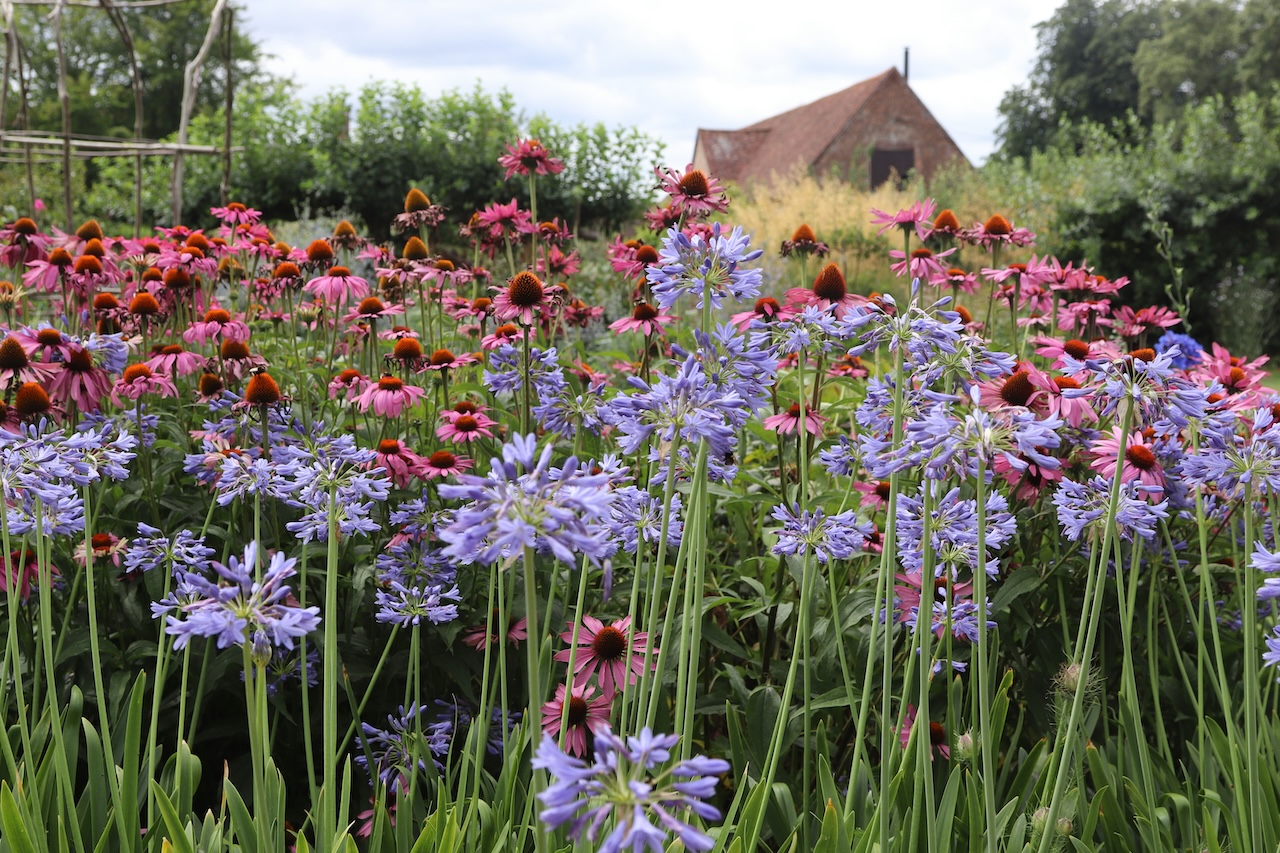
Salvias provide some of the most saturated blue, purple and rich red tones in the summer border. Salvia nemorosa varieties — 'Caradonna', 'Ostfriesland', 'Amethyst' — are reliably hardy and produce tall, vertical spikes that contrast beautifully with rounded or sprawling neighbours. For September and October colour, echinacea (coneflower) is outstanding: deep pink, white, orange and red varieties extend the border's performance well into autumn, and the dramatic seed heads that remain through winter add textural interest while providing food for seed-eating birds. Astrantia (masterwort) is a particularly useful choice for shaded or partially shaded positions, producing delicate, intricate pin-cushion flowers from June through August and self-seeding gently without becoming invasive. The RHS: perennials planting guide provides comprehensive guidance on establishing and maintaining perennial plantings.

Ornamental grasses and statement texture
Ornamental grasses occupy a unique and essential role in the low-maintenance garden. They provide movement — responding to the lightest breeze in a way that brings the garden alive — as well as architectural texture and a naturalistic quality that anchors plantings in their landscape. Almost without exception, established ornamental grasses are genuinely low-maintenance: requiring nothing more than an annual cut-back in late winter or early spring and occasional division every four or five years to maintain vigour.
Hakonechloa macra, the Japanese forest grass, is one of the finest grasses for partially shaded positions. Its arching, waterfall-like habit in soft golden-green tones, turning warm bronze in autumn and providing architectural structure even when dormant, makes it almost universally effective in garden design. It establishes slowly but is long-lived and entirely reliable once settled. For open, sunny positions, Stipa tenuissima (ponytail grass) produces a haze of fine, tactile foliage that moves in the softest wind, creating an almost meditative quality; Miscanthus varieties provide bold, upright structure and hold their feathery seed heads through winter for months of additional interest. For late-season colour and texture, Pennisetum and its close relatives produce attractive bottlebrush seed heads from late summer that are among the most beautiful things in the garden in early autumn light.
The RHS: Beginners guide to gardening is an authoritative starting point for understanding how to plant, establish and manage all of these plant categories successfully.
Bulbs for spring and autumn highlights
Bulbs represent the highest return-on-investment planting in any low-maintenance garden. Planted once, in appropriate conditions, the best varieties naturalise — spreading, multiplying and improving year after year — while the annual investment of care is effectively zero beyond the initial planting. The seasonal highlights they provide are disproportionately large relative to the effort involved, which makes them essential in any garden where low maintenance is a genuine priority.
For spring, narcissi (daffodils) are the gold standard of naturalising bulbs in UK gardens. A thoughtfully selected range of early, mid-season and late varieties — from the cheerful miniature 'Tête-à-Tête' in February through to the elegant, fragrant 'Pheasant's Eye' in May — extends the narcissus season across three full months. Planted in grass, under deciduous trees, in mixed borders or in containers, they are one of the great constants of the British spring garden and require no lifting or storage.
Alliums — the ornamental onions — are outstanding for late spring interest. Allium hollandicum 'Purple Sensation' and the giant-headed Allium giganteum both produce bold spherical flower heads on tall stems that are striking in their own right and equally valuable as structural elements in a mixed border once the flowers fade. For late-season colour, Nerine bowdenii is a revelation: producing vivid pink flowers through October and November when almost everything else in the garden is declining towards dormancy, it rewards a sunny, well-drained position with a brilliant autumnal flourish that makes a fitting finale to the growing year.

.jpg)



.svg)